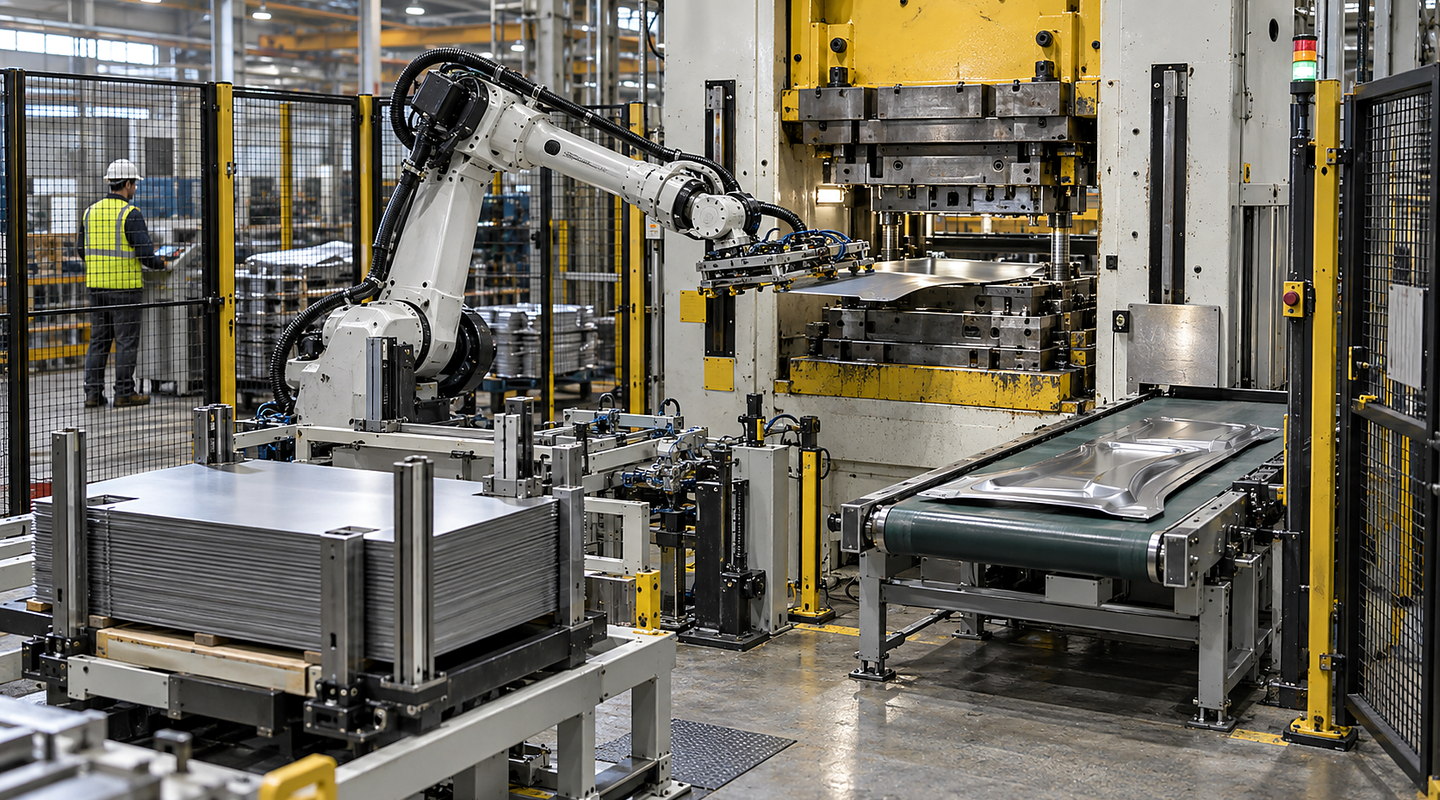
Sheet Metal Loading Robots Selection Guide
Choose sheet metal loading robots by comparing your parts, process, rate, access, data needs and required results.
Compare sheet-loading options against the actual sheet and stack range, the required receiving position and evidence for separation, pickup, transfer and release. Include surface acceptance, replenishment, machine delays and recovery when reviewing the complete cycle.
Use the same representative sheets and run-off criteria for every option, and identify which conditions remain unproven before selecting a route.
Compare options in the conditions where they must work — Sheet Metal Loading Robots
Plan sheet metal loading robots around your parts, process, cycle time, tooling, recovery and acceptance criteria. Discuss the highest-risk feasibility questions with Oxford Industrial Automation. A useful shortlist should show how every option copes with part, product and process variation for robotic sheet-metal machine loading and operator access, recovery and changeover.
Discuss your application
Ask every supplier the same questions
| Decision | What to ask | What to check |
|---|---|---|
| Part, Product and Process Variation for Robotic Sheet-Metal Machine Loading | What normal range, extreme and rate of change applies to part, product and process variation for robotic sheet-metal machine loading? | Representative samples and a controlled trial. |
| Arrival Pattern and Presentation | What normal range, extreme and rate of change applies to arrival pattern and presentation? | Representative samples and a controlled trial. |
| Required Cycle and Production Pattern | What normal range, extreme and rate of change applies to required cycle and production pattern? | Drawings, observation and interface measurements. |
| Tooling, Sensing and Process Interfaces | What normal range, extreme and rate of change applies to tooling, sensing and process interfaces? | Drawings, observation and interface measurements. |
| Operator Access, Recovery and Changeover | What normal range, extreme and rate of change applies to operator access, recovery and changeover? | Agreed operating and acceptance records. |
| Run-Off Criteria and Production Evidence | What normal range, extreme and rate of change applies to run-off criteria and production evidence? | Agreed operating and acceptance records. |
Include simpler approaches to robotic sheet-metal machine loading in your shortlist
| Approach | Often suitable when | Watch for |
|---|---|---|
| Sheet Metal Loading Robots | You need a dedicated solution for a clearly defined duty, product or part range and line interface. | Cycle time depends on the complete process rather than robot speed alone. |
| Purpose-Built Mechanical Automation for a Stable, Very High-Volume Task | Consider purpose-built mechanical automation where the sheet range, presentation and loading sequence are stable and the production duty justifies a dedicated mechanism. Confirm the scope with representative sheets and the actual receiving interface. | Review separation, transfer, release and surface results, together with replenishment, access and recovery. Identify the changes needed for a new sheet format rather than assuming a dedicated mechanism accommodates future variation. |
| Operator-Assisted Fixtures where Flexibility or Business Case Does Not Support a Robot Cell | Consider operator-assisted fixtures where format variation, operator judgement or the business case supports an assisted loading route. Define which separation, presentation, placement and checking tasks remain with the operator. | Assess the complete handling sequence, access, sheet support and recovery requirements for the assisted route. Compare accepted placements and production observations, with an application assessment of the work that remains manual. |
Pause before choosing when…
- Only perfect or hand-selected examples of repeatable production using robotic sheet-metal machine loading are available.
- No one has defined how run-off criteria and production evidence will be evaluated.
- The normal range for part, product and process variation for robotic sheet-metal machine loading is described only as “usually fine” but has not been bounded.
- Your operator, cleaning, maintenance or recovery access has not been considered.
- Quoted performance depends on another machine or data source that is not included.