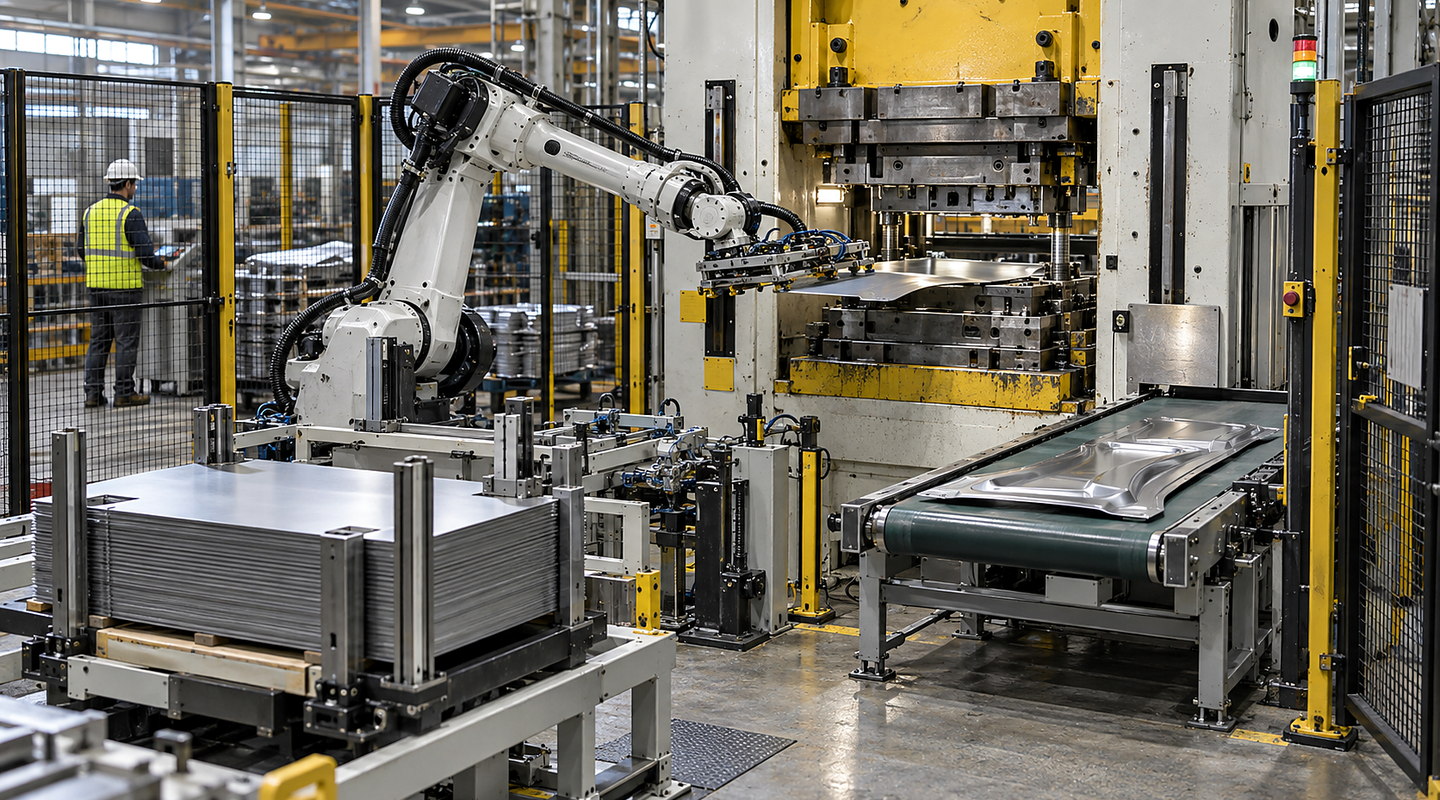
Sheet Metal Loading Robots FAQs
Straight answers to common questions about sheet metal loading robots, including suitable applications, limitations and what to send us.
Useful answers about sheet metal loading robots depend on your application, operating range and the results you need.
Your final sheet metal loading robots scope must also account for operator access, recovery and changeover, run-off criteria and production evidence, current regulations and the conditions at your site.
Get practical answers for your application — Sheet Metal Loading Robots
Plan sheet metal loading robots around your parts, process, cycle time, tooling, recovery and acceptance criteria. Discuss the highest-risk feasibility questions with Oxford Industrial Automation. The answers below explain suitable applications for Sheet Metal Loading Robots, what information helps and what still needs an application-specific check.
Discuss your application
Practical answers about sheet metal loading robots
How can we automate loading sheet metal into our process?
For sheet metal loading robots, define part, product and process variation for robotic sheet-metal machine loading, arrival pattern and presentation, cycle balance and recovery cases first. Use a focused feasibility trial to resolve the highest-risk handling or process step and agree run-off criteria and production evidence before the complete cell is designed.
How should a project for sheet metal loading robots begin?
Define the real duty and collect representative samples or observations. Record part, product and process variation for robotic sheet-metal machine loading, arrival pattern and presentation, and required cycle and production pattern before choosing an approach.
Can you quote sheet metal loading robots from a short description?
An early budget range may be possible, but a reliable scope for repeatable production using robotic sheet-metal machine loading needs the product or part range, line connections, site conditions and your requirements for run-off criteria and production evidence.
What information should we send about sheet metal loading robots?
Share authorised drawings or photographs, representative examples from repeatable production using robotic sheet-metal machine loading, current process data, your production pattern, available services, space and known safety or quality requirements.
How will performance be checked?
Use an agreed trial covering normal, difficult and fault conditions for repeatable production using robotic sheet-metal machine loading. Judge the complete system using the agreed requirements for run-off criteria and production evidence, not a catalogue maximum.
What are the main limitations?
Cycle time depends on the complete process rather than robot speed alone. Part presentation, tolerances and recovery cases must be included in feasibility work. Collaborative operation or automatic handling cannot be assumed safe without an application assessment.
What alternatives should be considered for repeatable production using robotic sheet-metal machine loading?
Compare purpose-built mechanical automation for a stable, very high-volume task with operator-assisted fixtures where flexibility or business case does not support a robot cell. For Sheet Metal Loading Robots, the practical option may be simpler than the most automated one.
Can the proposed solution guarantee regulatory compliance?
No solution can guarantee compliance on its own. Applicable law, current standards, risk assessment, validation and conformity responsibilities must be addressed for your complete application.
Who will handle my enquiry?
Oxford Industrial Automation will receive enquiries from sheetmetalloadingrobots.co.uk. Call 01865 416830 or email sales@oxfordindustrialautomation.co.uk to speak with the team directly.