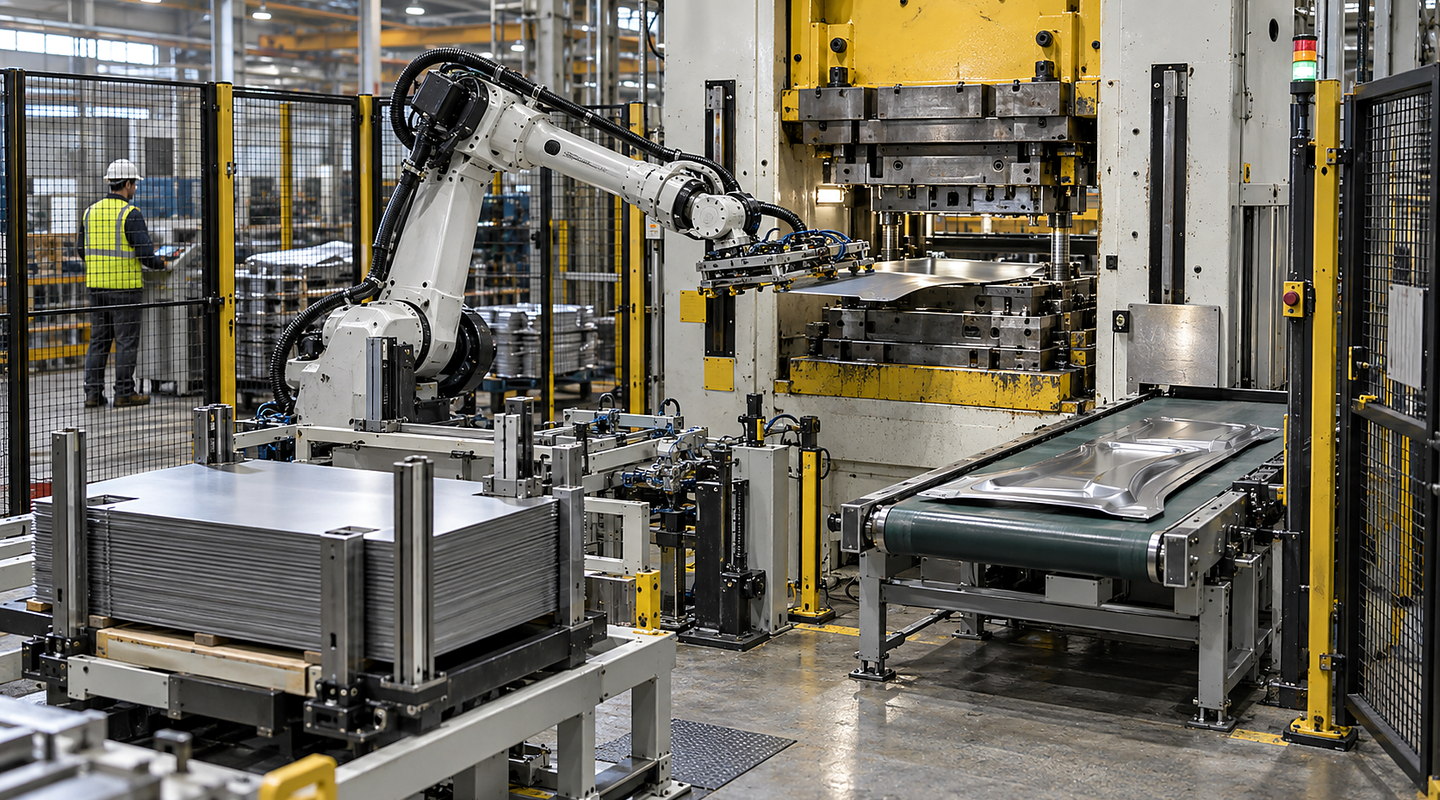
Sheet Metal Loading Robots Run-off and ramp-up checklist
What evidence should be agreed before acceptance testing for sheet metal loading robots?
In brief
Agree sheet-loading acceptance evidence for the included sheet and stack range: single-sheet pickup, placement at the receiving machine, complete release, acceptable surface condition and the required production pattern. Define how each result will be checked and recorded before the run-off.
Include replenishment, normal machine delays, format changes and assessed recovery cases where they belong to the intended operation. The process guide links these checks to the complete transfer sequence.
On the production floor
Turn your production information into clearer decisions — Sheet Metal Loading Robots
Plan sheet metal loading robots around your parts, process, cycle time, tooling, recovery and acceptance criteria. Discuss the highest-risk feasibility questions with Oxford Industrial Automation. Use this guide to resolve run-off criteria and production evidence before it limits the final system.
Run-Off Criteria and Production Evidence: condition, range and effect on your process
Current condition
Record the sheet and stack condition, tooling or setup revision, receiving position and operating state with each result. State the method for checking single-sheet pickup, placement, release and surface condition, including any limit on what the check can establish.
Realistic range
Select representative combinations of dimensions, thickness, weight, surface condition and protective film from the proposed scope. Include normal replenishment and receiving-machine delays, and list formats or conditions not covered by the run-off.
Effect on the system
Separate double picks, placement outside the agreed requirement, incomplete release and unacceptable surface marks in the results. Record the affected sheets, interruptions and follow-up actions; agree who can accept the evidence or require further assessment.
Before you contact us
Five questions about run-off criteria and production evidence for your application
Who can confirm this information?Identify the person responsible for run-off criteria and production evidence in production, quality, engineering or operations.
How representative is the sample?Include age, supplier, batch, environment and upstream process state where they affect sheet metal loading robots.
What is the difficult condition?Identify representative separation or transfer problems from production and agree how they can be assessed within the application review. Record recovery evidence and outstanding limitations without treating a completed robot movement as proof of a satisfactory loaded sheet.
How will you judge the result?Agree the method, repetitions, acceptable range, result record and the response if the observed result falls outside the agreed range.
What else must be coordinated?Your final sheet metal loading robots scope must also account for operator access, recovery and changeover, run-off criteria and production evidence, current regulations and the conditions at your site.
Connected details
Review run-off criteria and production evidence as part of the complete system
Question 1
Part, Product and Process Variation for Robotic Sheet-Metal Machine Loading
For Sheet Metal Loading Robots Run-off and ramp-up checklist, describe the current position, required outcome, acceptable limits and known exceptions for part, product and process variation for robotic sheet-metal machine loading. That lets us compare options against your real production rather than one nominal value.
Question 2
Arrival Pattern and Presentation
For Sheet Metal Loading Robots Run-off and ramp-up checklist, describe the current position, required outcome, acceptable limits and known exceptions for arrival pattern and presentation. That lets us compare options against your real production rather than one nominal value.
Question 3
Required Cycle and Production Pattern
For Sheet Metal Loading Robots Run-off and ramp-up checklist, describe the current position, required outcome, acceptable limits and known exceptions for required cycle and production pattern. That lets us compare options against your real production rather than one nominal value.
Question 4
Tooling, Sensing and Process Interfaces
For Sheet Metal Loading Robots Run-off and ramp-up checklist, describe the current position, required outcome, acceptable limits and known exceptions for tooling, sensing and process interfaces. That lets us compare options against your real production rather than one nominal value.
Question 5
Operator Access, Recovery and Changeover
For Sheet Metal Loading Robots Run-off and ramp-up checklist, describe the current position, required outcome, acceptable limits and known exceptions for operator access, recovery and changeover. That lets us compare options against your real production rather than one nominal value.
Question 6
Run-Off Criteria and Production Evidence
For Sheet Metal Loading Robots Run-off and ramp-up checklist, describe the current position, required outcome, acceptable limits and known exceptions for run-off criteria and production evidence. That lets us compare options against your real production rather than one nominal value.